![EarthScan_ID_White_RGB-01.png]](https://knowledgebase.earth-scan.com/hs-fs/hubfs/EarthScan_ID_White_RGB-01.png?height=40&name=EarthScan_ID_White_RGB-01.png)
After reading this article, you will learn:
Drought signal overview
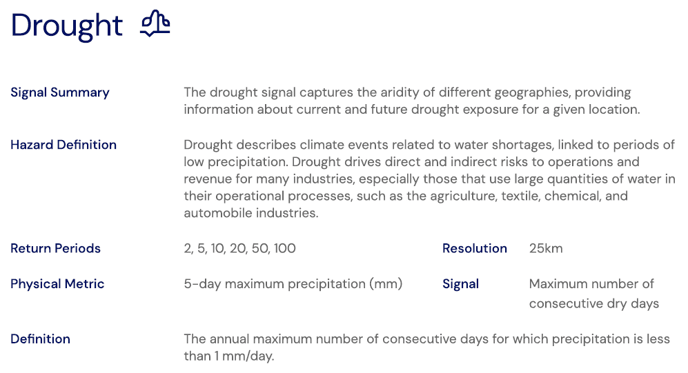
The table below shows a summary of the drought signal.
What is drought?
Drought describes climate events related to water shortage. There are a number of different categories of drought.
Meteorological drought describes periods of weather-related low water supply from sources such as rainfall, snow or meltwater. Meteorological drought is a precursor to Hydrological drought, which describes the impact of drier periods on water levels in river systems, reservoirs, wetlands and the water table. Hydrological drought can lag meteorological drought, and can take longer to recover. When drought reduces water availability in soils and impacts agricultural industries, it becomes Agricultural drought. Drought becomes socioeconomic and places a region under water stress when regional water demand exceeds water supply, creating wide-ranging socio-economic impacts.
How will climate change impact drought?
As climate change intensifies, we expect drought to increase in arid and semi-arid climates such as the mediterranean (1). Some locations in the northern hemisphere are expected to see an increase in precipitation levels, resulting in fewer droughts. These regions could still experience water stress, if demand for water resources increases. In some colder or mountain regions, temperature increases mean that less snow accumulates during winter, resulting in less meltwater available as water supplies during summer (2).
How can drought impact physical assets and business continuity?
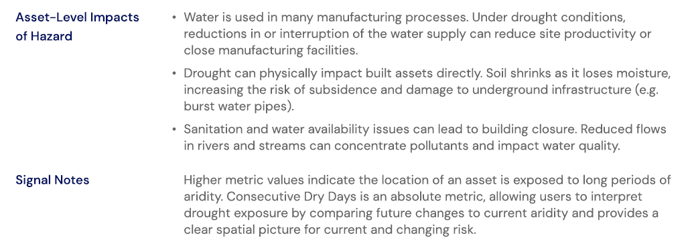
Drought creates direct and indirect risks to operations and revenue for many industries, especially those that use large quantities of water in their operational processes, such as the agriculture, textile, chemical and automobile industries.
Drought can physically impact built assets directly. Soil shrinks as it loses moisture, which increases the risk of subsidence and can damage underground infrastructure (e.g. burst water pipes). Sanitation and water availability issues can lead to building closure, and reduced flows in rivers and streams can concentrate pollutants and therefore threaten water quality.
Reduced water levels impact businesses relying on river shipping. In 2018, a combination of drought and heat waves forced local German power plants to reduce their energy output due to a lack of available cooling water (3). Low water levels also meant that ships could no longer supply sufficient fuel, such as hard coal.
Drought can increase costs to production because it places pressure on local infrastructure - transport, water supply and energy. Electricity production that requires cooling water to maintain safe operations and hydroelectric power may become unavailable (4). There is high confidence that concurrent heat waves and droughts have increased in frequency over the last century (AR6 WG1, Chapter 11). When heat waves coincide with droughts, electricity demands can grow, compounding stress on the grid.
Drought impacts local people's health and well-being. Limited water for household use and impacts on sanitation and health all mean greater risk of disease. This can impact local employees and have a knock-on effect on productivity.
Drought can increase the risk of wildfire, especially when combined with heat waves. 2021 saw the American midwest locked into a cycle of heat, drought and wildfire, making last year's U.S. wildfire season one of the most destructive on record. As well as the cost of repairing physical damage to built assets, critical infrastructure and inventories, there are knock-on implications for businesses, such as increased insurance costs and the potential for non-renewals.
Drought Metric
The drought signal captures how arid different geographies are, providing information about current drought exposure and how it might evolve in the future for a given location. The key metric for the Drought Risk Category and EarthScan Rating is Consecutive Dry Days (CDD).
Consecutive Dry Days is a standard climate science metric that captures how arid different geographies are, providing information about current drought exposure and how it might evolve in the future for a given location.
Return periods and extreme values for the Drought Risk Category are identified using machine learning techniques, Artificial Intelligence (AI) and Bayesian Inference. (Learn more about our statistical approach in our Methodology Overview). These methods take into account a large ensemble of information to arrive at a maximum estimate for this Risk Category.
Data Sources
CMIP6
The Drought Risk Category incorporates ten state-of-the-art models from the sixth Coupled Model Intercomparison Project (CMIP6). These models are used to form the basis of the latest UN IPCC sixth Assessment Report (AR6).
ERA5
The Drought Risk Category also incorporates historical and near real-time observations from the ERA5 dataset from the ECMWF (European Centre for Medium-Range Weather Forecasts).
ERA5 is the most comprehensive reconstruction of recent historical climate. It combines hundreds of millions of observations (satellites, aircraft and in-situ stations) into global estimates using advanced modeling and data assimilation systems.
Sources
- Changes in Climate Extremes and their Impacts on the Natural Physical Environment
- A low-to-no snow future and its impacts on water resources in the western United States
- Worsening drought risk impacts 55 million people every year, says WWF report
- Drought and climate change impacts on cooling water shortages and electricity prices in Great Britain