![EarthScan_ID_White_RGB-01.png]](https://knowledgebase.earth-scan.com/hs-fs/hubfs/EarthScan_ID_White_RGB-01.png?height=40&name=EarthScan_ID_White_RGB-01.png)
After reading this article, you will learn:
Precipitation signal overview
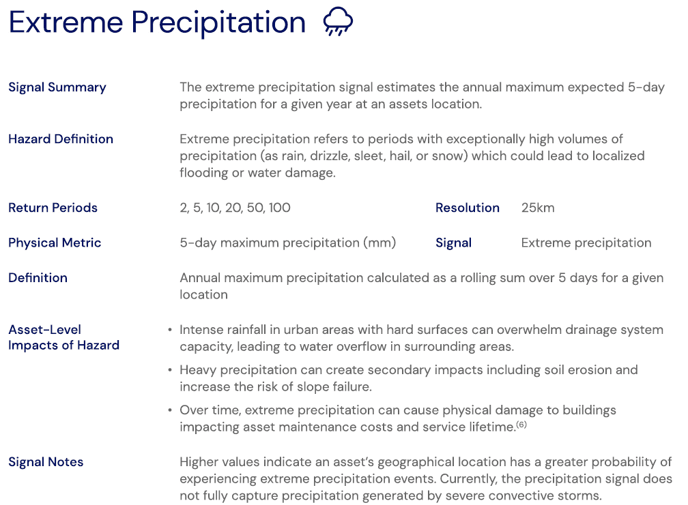
The table below shows a summary of the precipitation signal.
(6) https://www.mdpi.com/2075-5309/10/3/53
What is precipitation?
Precipitation is defined as water (rain, drizzle, sleet, hail and snow) that forms in our atmosphere and falls to the earth’s surface. Extreme precipitation refers to periods with exceptionally high volumes of precipitation, relative to historical conditions (1980-2020).
The Precipitation Risk Category in EarthScan indicates how asset level exposure to extreme precipitation events increases or decreases for a given location across different climate scenarios, return periods and time horizons.
How will climate change impact precipitation?
Climate change is driving changes to the planet's hydrological cycle and precipitation patterns, in particular, the extremes. The latest IPCC report found that high Return Period events will experience a more rapid increase in frequency than low Return Period events, suggesting that precipitation extremes are highly likely to become more frequent in most locations [IPCC AR6 WG1, Chapter 11].
Precipitation patterns are likely to experience regional changes in the future. On a continental scale, increased heavy precipitation events have become more frequent and more intense over North America, Europe, and Asia; these trends are projected to continue in the future, though it is not a simple linear relationship. Some regions are expected to see more intense precipitation towards the end of the century (e.g. northern Europe and much of North America), while increases in agricultural and ecological droughts are projected to increase in other regions (e.g. southern Europe.)
How can extreme precipitation impact built assets and business operations?
Climate change is driving change to precipitation in three main ways:
- Precipitation intensity: the amount of rainfall over a specific time period
- Precipitation frequency: the rate at which rainfall occurs over a specific time period
- Changes in precipitation patterns and extreme variability in weather patterns over the medium and long-term
These changes to precipitation have the potential to increase asset-level exposure to physical assets and business continuity. Some direct impacts to physical assets as a result of increased precipitation levels include:
- Increase in risk of flooding.
- Damage to building materials and structural integrity. For example, increasing precipitation damages steel within concrete, weakening its structure.
- Access to sites can be disrupted by damage to surrounding infrastructure.
- Increased maintenance costs, especially to buildings with open layouts exposed to driving rain.
- Damp, mold and decay issues are caused by an increase in water levels in porous materials, such as brick or stone.
Longer-term changes to precipitation patterns and variability can impact the cost, availability, quality, and long-term security of products and materials across supply chains. This is especially true for the agricultural, food and textiles industries, which could lead to reduced production capacity and a decrease in revenue.
Precipitation Metric
The Precipitation signal is based on the 5 day maximum precipitation (mm) metric. This metric calculates annual maximum precipitation as a rolling sum over 5 days for a given location. 5 day maximum precipitation is based on precipitation data (rain, drizzle, sleet, hail and snow) measured or observed at a location (i.e. for meteorological purposes, rain gauges are usually placed at a height of 0.5 to 1.5 m above the ground). Higher metric values indicate that the location of an asset is more exposed to precipitation damage.
We determine asset-level exposure to extreme precipitation by looking at two dimensions of change to the physical metric:
- absolute exposure (5 day maximum precipitation mm)
- relative change in exposure (5 day maximum precipitation mm)
Absolute and relative changes in exposure give insight into the susceptibility of an asset to precipitation-induced damage. A relative change with respect to present-day or historical exposure provides perspective relative to conditions which have been experienced. An absolute change can be used to infer an asset’s vulnerability with respect to building regulations, for example.
Data Sources
CMIP6
The Precipitation Risk Category incorporates several state-of-the-art models from the sixth Coupled Model Intercomparison Project (CMIP6). These models are used to form the basis of the latest UN IPCC sixth Assessment Report (AR6).
ERA5
The Precipitation Risk Category also incorporates historical and near real-time observations from the ERA5 dataset from the ECMWF (European Centre for Medium-Range Weather Forecasts).
ERA5 is the most comprehensive reconstruction of recent historical climate. It combines hundreds of millions of observations (satellites, aircraft and in-situ stations) into global estimates using advanced modeling and data assimilation systems.