![EarthScan_ID_White_RGB-01.png]](https://knowledgebase.earth-scan.com/hs-fs/hubfs/EarthScan_ID_White_RGB-01.png?height=40&name=EarthScan_ID_White_RGB-01.png)
After reading this article, you will learn:
Wildfire signal overview
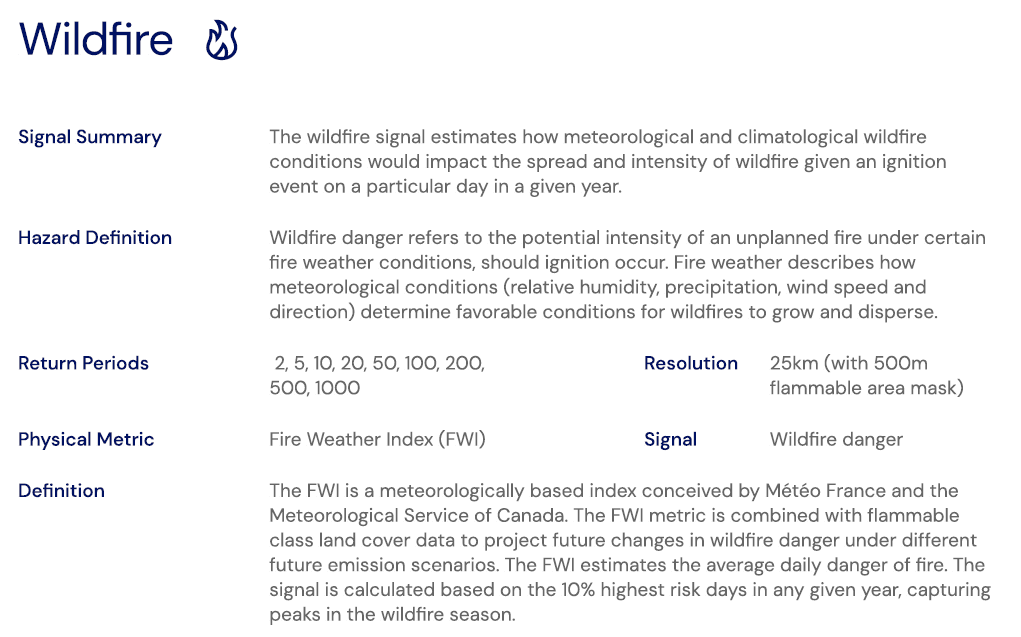
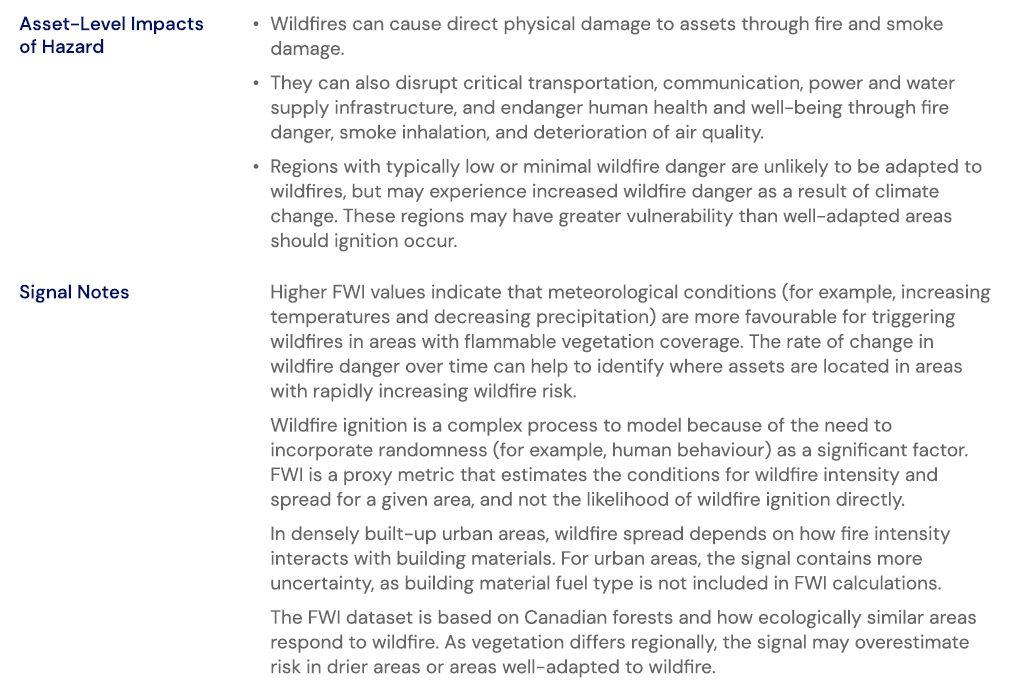
The table below shows a summary of the wildfire signal.
What are wildfires?
Wildfires are unplanned fires that burn in a natural area, such as a forest or grassland. Wildfires are a climate hazard that cause direct physical damage and disruption to assets around the world.
Climate change is affecting wildfires in two key ways:
- warmer and drier conditions make the vegetation that provides the fuel for wildfires more combustible.
- wildfire seasons are starting earlier, and lasting longer.
Using the Wildfire Risk Category, you are able to incorporate intelligence on wildfire danger as part of your climate risk assessments.
What does the Wildfire signal estimate?
The Wildfire signal provides you with climate intelligence on wildfire danger to built assets. The Wildfire signal estimates changes to wildfire danger over time and across different future emission scenarios.
Wildfire danger is a term used in wildfire risk assessment and management to describe potential wildfire behaviour and spread should there be ignition under certain fire weather conditions. ‘Fire weather’ describes meteorological conditions (such as relative humidity, precipitation, wind speed and direction) that are favorable for wildfires to grow and disperse.
The Wildfire signal can be used to identify assets located in areas where wildfire danger is high, and areas where wildfire danger is increasing over time.
The signal considers how meteorological and climatological wildfire conditions would impact the spread and intensity of wildfire should ignition of a wildfire happen on a particular day, given the type of vegetation coverage of an area.
For example, increasing temperatures and decreasing precipitation are factors that increase wildfire danger, as they impact the level of moisture available in the fuel available, while wind speed can impact the potential spread and growth of wildfire.
The signal estimates the potential intensity of wildfire if ignition were to happen given projected meteorological conditions, providing an indication of how conducive the conditions are for burning. It’s an indicator of how dangerous a wildfire could be in terms of its intensity and spread if ignition was to occur. The signal does not estimate the likelihood of an ignition event occurring.
Wildfire ignition is a complex process to model because it contains a significant degree of randomness. For example, in 2019 Yorkshire fires were started by a barbecue. In general, many fires are started by human negligence such as poorly managed forests (overgrown with fuel) or fallen power lines. They can also be started in the absence of human activity; for example, by lightning.
Wildfire Metric
The Fire Weather Index (FWI) is the metric used to generate the Wildfire signal. The FWI is a meteorologically based index generated by Météo France and the Meteorological Service of Canada, and used worldwide to estimate and communicate wildfire danger. The FWI physical metric is multivariate, calculated based on daily temperature, wind speed, relative humidity, and precipitation data from ERA5. The Wildfire signal estimates the average daily danger of fire, based on the 10% highest fire danger days of the year from 1970-2100. By taking the top 10% of FWI values, the signal captures times of peak danger across the wildfire season.
Interpreting the Wildfire signal
FWI is calculated as an index, and produces a unitless value to represent Wildfire Danger. Higher FWI values indicate that meteorological conditions are more favorable for triggering wildfires. There is not a standard industry threshold for which FWI values, however once the FWI exceeds 38, you can safely assume the danger is high. In EarthScan, the highest values FWI metric reaches in Europe and the US is around 150.
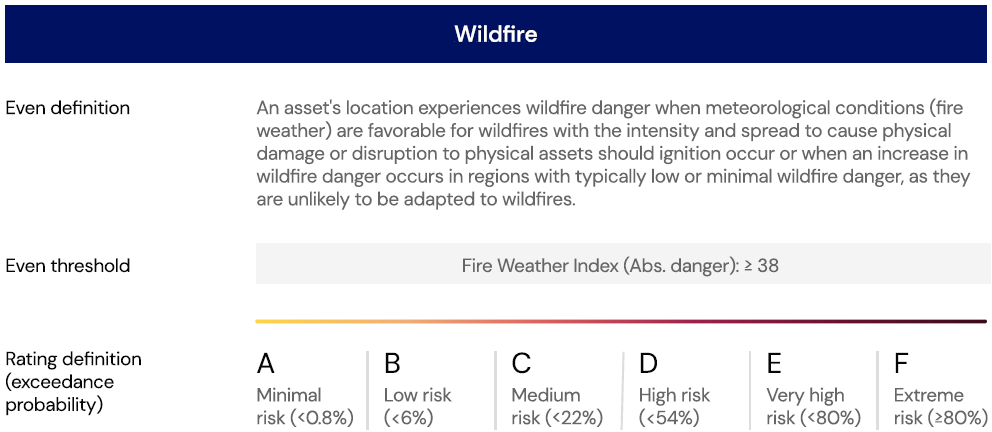
As a metric, the Fire Weather Index can be harder to contextualise than a temperature or wind speed. It is not the case that you only need to take notice once it hits 38: as the European Environment Agency indicates, values less than 38 still deserve notice and consideration.
The European Environment Agency and European Climate Adaptation Platform (Climate-ADAPT) recommends the following thresholds of concern for physically interpreting the FWI:
Very low: FWI less than 5.2
Low: FWI between 5.2 and 11.2
Moderate: FWI between 11.2 and 21.3
High: FWI between 21.3 and 38.0
Very High: FWI between 38.0 and 50
Extreme danger: FWI greater than 50
High FWI values indicate that an asset is in danger of being affected by a wildfire, should an ignition event occur. This could translate to financial loss due to direct damage, danger to human health, loss of raw materials (e.g., timber), or disruption to transportation, power, or water supply. A large increase in FWI over time suggest a substantial change in wildfire danger and users should consider adaptation measures.
The 2-year return period is the suggested starting point to understand your average wildfire danger. We also suggest exploring wildfire danger at longer 5- and 10-year return periods, as it can take years for forest growth to return to previous levels following wildfire damage.
Data Sources
- CMIP6
The Wildfire Risk Category incorporates several state-of-the-art models from the sixth Coupled Model Intercomparison Project (CMIP6). These models are used to form the basis of the latest UN IPCC sixth Assessment Report (AR6).
- ERA5
The Wildfire Risk Category also incorporates historical and near real-time observations from the ERA5 dataset from the ECMWF (European Centre for Medium-Range Weather Forecasts).
ERA5 is the most comprehensive reconstruction of recent historical climate. It combines hundreds of millions of observations (satellites, aircraft and in-situ stations) into global estimates using advanced modeling and data assimilation systems.
- Fire Weather Index (FWI)
The Wildfire Risk Category uses the FWI dataset, produced by the ECMWF in its role of the computational centre for fire danger forecast of the Copernicus Emergency Management Service (CEMS), on behalf of the Joint Research Centre which is the managing entity of the service.
- ESA WorldCover 2020
The European Space Agency’s WorldCover provides a baseline global land cover product at 10m resolution for 2020 based on Sentinel-1 and 2 satellite data.