![EarthScan_ID_White_RGB-01.png]](https://knowledgebase.earth-scan.com/hs-fs/hubfs/EarthScan_ID_White_RGB-01.png?height=40&name=EarthScan_ID_White_RGB-01.png)
After reading this article, you will learn:
Why do we use regional climate models?
Global climate models (GCMs) are not sufficient tools on their own for understanding climate change at a local scale. These models are limited by the way they discretize each point on the globe into a grid. Grid boxes within global climate models are large, often exceeding 100 km.
To hone in on details of specific meteorological phenomena, or provide more comprehensive information about a specific region or location, downscaling with regional climate models is the preferred method.
What are regional climate models?
Regional climate models (RCMs) provide higher resolution information on the atmosphere and land surface. Regional models utilize a finer grid (of the order of 10-25 km) than their global counterparts.
As a trade off, they can only cover a subset of the globe. Instead, regional models are operated at high resolution over a specific region - for example, Europe - with global model information ingested at their boundaries, in a process called dynamical downscaling. Downscaling involves inferring high-resolution, detailed information from a coarser source.
These regional climate models enable topographic features such as coastlines, valleys, and mountain ranges to be resolved more appropriately, and provide improved detail of local atmospheric circulation and meteorological phenomena (such as storms).
These are important capabilities as small-scale atmospheric interactions and the surface topography can strongly influence meteorology; for example, resolving topographic features is critical to obtain a representative assessment for how an incoming tropical cyclone may evolve once it has made landfall.
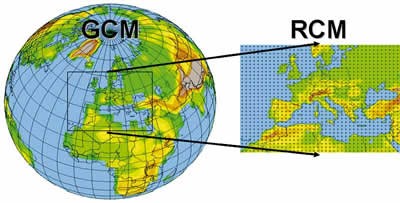 RCM domain embedded in a GCM grid. Source: F. Giorgi, World Meteorological Organisation Bulletin 52(2), April 2008.
What is CORDEX?
The Coordinated Regional Downscaling Experiment (CORDEX) is an international collaborative programme established by the World Climate Research Programme (WRCP).
It involves a network of modelling centres around the world, each running their own regional climate model to provide a more detailed perspective of local extreme events across future climate scenarios.
While these regional models are typically used for weather forecasting, their use by the CORDEX community gives the same perspective going forward in time as those global models within the CMIP, albeit with higher spatial resolution. This enables a better representation of future projections of extreme wind in EarthScan™ and, in future, extreme precipitation and associated pluvial flooding.