![EarthScan_ID_White_RGB-01.png]](https://knowledgebase.earth-scan.com/hs-fs/hubfs/EarthScan_ID_White_RGB-01.png?height=40&name=EarthScan_ID_White_RGB-01.png)
After reading this article, you will learn:
Heat stress signal overview
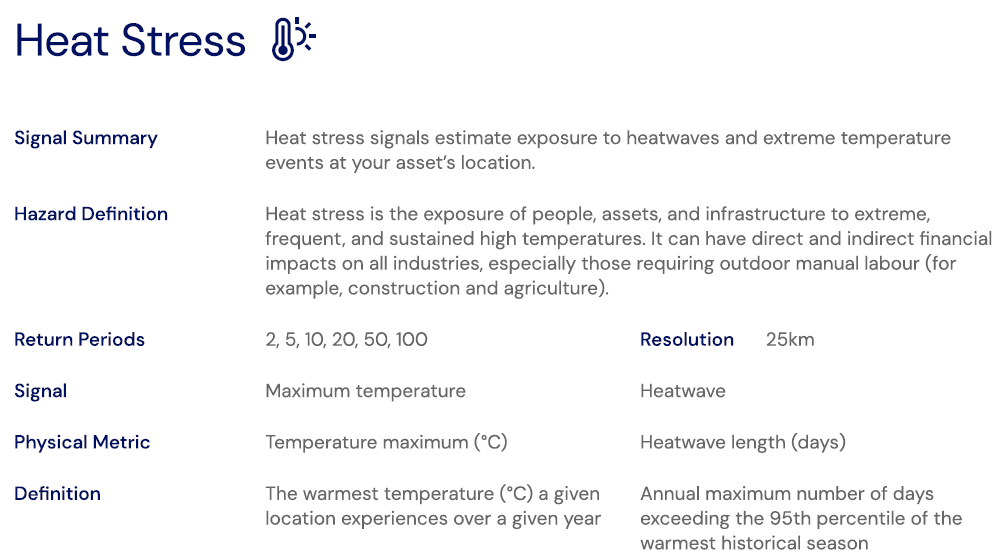
The table below shows a summary of the heat stress signal.
What is heat stress and how will climate change impact it?
Heat stress is the exposure of people, assets and infrastructure within a specific geographical area to more extreme, frequent and sustained temperature increases. Climate change has been increasing average global temperatures at an average of 0.2°C per decade since pre-industrial times (1). Heat wave lengths are projected to increase with climate change, reaching levels that will make some regions uninhabitable for humans during a large portion of the year (2).
Companies around the world are putting measures in place to reduce their carbon emissions to prevent global average temperatures from rising above the 1.5°C ‘best case scenario’ established in the Paris Agreement. It’s important to keep in mind that the impacts of temperature increases are experienced locally. Furthermore, global averages don’t convey the potential range of regional change, which, by 2100, could be up to 10°C in areas like the Arctic.
Temperatures can vary significantly even across a relatively small area. This is particularly true of cities, which can be up to 12°C warmer than the surrounding countryside. Even within individual cities, some neighborhoods are hotter than others. This localized warming within cities is known as the urban heat island effect.
How can heat stress impact physical assets and business continuity?
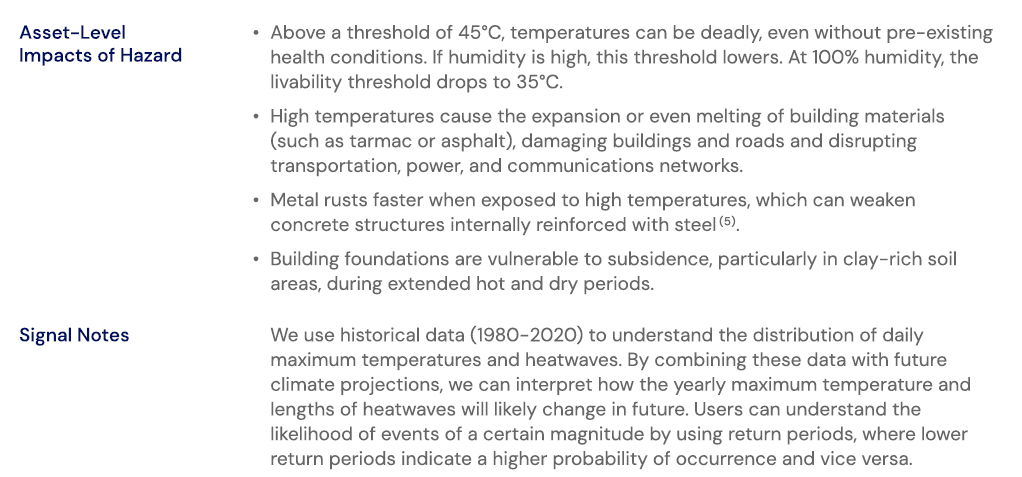
Heat stress has direct and indirect financial impacts on all industries, especially those that require outdoor manual labor, such as the construction and agricultural industries. Temperatures above 45℃ (approximately, depending on humidity) can be deadly. If humidity is high, this temperature limit becomes lower. High temperatures can damage infrastructure, disturb transportation, power and communications networks and increase the probability of wildfire.
Impacts that can arise as a result of increasing heat stress risk:
- Extreme heat changes the shape of building materials, which can damage building structures, fixtures and fittings through expansion and buckling. Extreme heat can also reduce an assets’ service-life.
- Rising temperatures reduce soil moisture. Dry soil hardens and shrinks, which can affect building foundation stability, lead to subsidence issues, and damage underground infrastructure, such as burst water pipes.
- Overheating can cause severe damage to technological assets, such as internet servers.
- Rates of degradation processes (e.g. weathering) to materials speed up as average temperatures increase, causing a rise in asset maintenance costs.
- The cost of utilities increases due to higher energy demand and usage for cooling.
- There is an increased risk of power outages due to a combination of increasing demand and a lowered ability of transmission lines to carry power in hot weather.
- Site access is disrupted by damage to infrastructure; buckling roads and melting tarmac causes road closures and transport delays.
- Increased internal temperatures can lead to a loss of productivity in the workplace.
- Employees exposed to heat can show signs of illness, hospitalizations and, in extreme cases, heat-related death whilst at work. This is exacerbated by increased humidity.
Heat Stress Metrics
In EarthScan, the Heat Stress signal is based on two key physical metrics:
- Temperature maximum (°C)
- Heat wave length (days)
The temperature maximum metric is defined as the warmest day (in ℃) that a given location experiences throughout a one-year period. This is identified by using daily maximum air temperature measurements, taken at 2 meters above the ground, to understand how the yearly maximum temperature has changed in the past.
The heat wave length metric refers to the maximum number of days in a year exceeding the 95th percentile of the warmest season, computed over the historical period (1980-2020). Heat waves are defined with respect to local climate; for example, a heat wave in Norway may not reach the same temperature maximum as a heat wave in Spain.
We use historical data (1980-2020) to understand the distribution of daily maximum temperatures and heat waves. These distributions are combined with future climate projections to help us interpret how the yearly maximum temperature and lengths of heat waves will likely change in the future. You are able to effectively sample these distributions by choosing different return periods, where lower return periods indicate a higher probability of occurrence and vice versa.
We determine asset-level exposure to heat stress by looking at three dimensions of change to these physical metrics:
- Absolute temperature maximum (℃)
- Relative change in temperature maximum (℃)
- Absolute heat wave length (days)
Data Sources
CMIP6
The Heat Stress Risk Category incorporates several state-of-the-art models from the sixth Coupled Model Intercomparison Project (CMIP6). These models are used to form the basis of the latest UN IPCC sixth Assessment Report (AR6).
ERA5
The Heat Stress Risk Category also incorporates historical and near real-time reanalysis from the ERA5 dataset from the ECMWF (European Centre for Medium-Range Weather Forecasts).
ERA5 is the most comprehensive reconstruction of recent historical climate. It combines hundreds of millions of observations (satellites, aircraft and in-situ stations) into global estimates using advanced modeling and data assimilation systems.