![EarthScan_ID_White_RGB-01.png]](https://knowledgebase.earth-scan.com/hs-fs/hubfs/EarthScan_ID_White_RGB-01.png?height=40&name=EarthScan_ID_White_RGB-01.png)
After reading this article, you will learn:
Wind signal overview
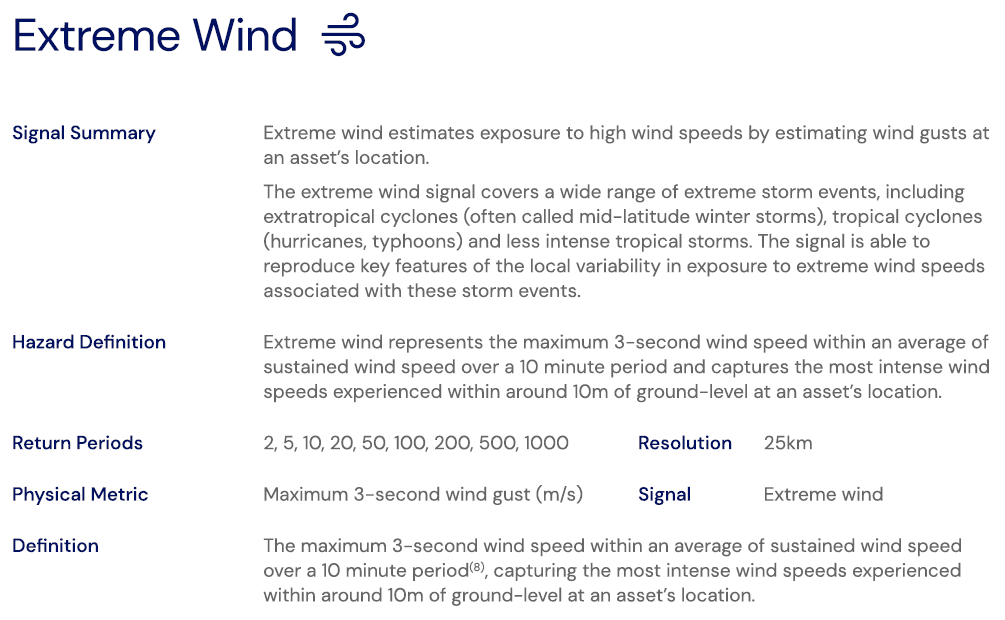
The table below shows a summary of the wind signal.
(8) Definition follows that given by the World Meterological Organization (WMO)
(9) https://www.ipcc.ch/report/ar6/wg1/
What is wind risk?
The Wind Risk Category in EarthScan indicates your exposure to extreme wind events at your assets location. Changes to your Wind Risk Rating over time indicate how your exposure to wind speeds changes at your assets location across different climate scenarios and return periods. Extreme wind events can occur during extreme weather events such as storms, hurricanes, tornadoes, etc., and are capable of causing physical damage to assets.
How will climate change impact wind speeds?
Projections of climate-induced changes to wind speed are variable without any compelling global trends. This indicates that climate change is driving an increase in wind speed intensity in some locations, a decrease in others and in many locations, there are no projected changes over the next century.
Wind intensity can vary rapidly over very short periods of time; it is often the short bursts of very high speeds that cause the greatest damage to physical assets and critical infrastructure. Many extreme wind events occur during storms. Storms are complex systems driven by atmospheric and ocean exchanges of heat and energy, and are difficult to both measure and model. As climate change progresses, some parts of the climate system are strengthening while other parts weaken. This makes it difficult to untangle precisely how storms and climate change are linked.
However, rising sea levels mean that coastal flooding from hurricanes and storms is expected to increase under climate change (1). This will worsen the impacts of storm surges and lead to storm-related coastal flooding in locations that wouldn’t have typically flooded in the past.
How can extreme wind impact physical assets and business continuity?
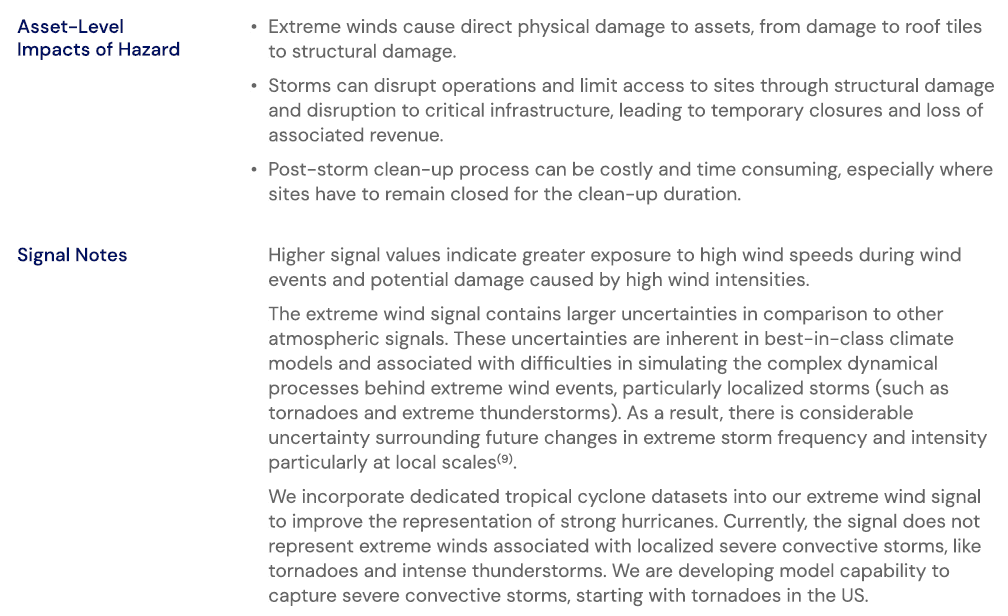
Examples of the impacts that could potentially arise as a result of extreme wind events include:
- Wind uplift damages roofing and tiles, which is exacerbated by wind-driven rain.
- Wind damages building structures, fixtures and fittings.
- Structural damage to power infrastructure leads to power outages.
- Extreme wind limits access to sites and can lead to temporary closures.
- The clean-up process after storms can be extremely costly and time consuming.
- Stronger winds spread corrosive salt-spray further in coastal locations.
Wind Metric
The Wind Risk Category in EarthScan is based on an extreme wind metric. The extreme wind signal shows the annual maximum wind intensity (in meters per second, ms-1).
Extreme winds (and maxima wind speeds) can be produced by three different weather regimes:
1) small-scale convective events, e.g. tornadoes
2) synoptic weather systems, e.g. passage of cold frontal systems
3) cyclones, e.g. hurricanes
The extreme wind signal is derived using daily wind gust data (taken at 10m above the ground), which represents the maximum 3-second wind intensity per day. While the definition of “extreme” wind varies regionally, it is generally agreed that wind gusts are defined as sudden (yet brief) increases in wind intensity.
Within an extreme wind event, wind gusts are short-time periods where wind speed exceeds the mean wind speed over a specific time range. They represent a sudden increase in wind speed. Wind gusts are defined as the ‘the maximum 3-second wind speed, within an average of sustained wind speed, over a specific time period (mins)’. This definition follows that given by the World Meteorological Organization (WMO).
The extreme wind signal represents the most extreme wind intensities that are experienced near (within around 10m) the earth’s surface. The greater the extreme wind signal value, the more susceptible an asset is to wind damage caused by weather phenomena which generate high wind intensities. Currently, the modeling underpinning the extreme wind signal in EarthScan accounts for cyclones and hurricanes, but does not account for smaller-scale events such as tornadoes.
Data Sources
Observational data on extreme wind is less readily available than other datasets; the most extreme wind speeds during extreme wind events only occur for short periods of time, and can be highly localized. Wind gusts measurements are often only applicable to the immediate area surrounding a weather station or buoy. At very extreme wind speeds, measurement devices can be damaged, destroyed or record inaccurate data when wind speeds exceed the range they are designed for.
In 2022, we’ve incorporated CORDEX datasets into our signals, unlocking capabilities to generate an extreme wind signal. CORDEX provides improved information for asset-level extreme wind risk analysis in comparison to global climate models as the CORDEX models use a higher spatial resolution.
Alongside the CORDEX simulations, we use ERA5 reanalysis data (i.e. values derived via a technique that combines observations with numerical weather model simulations over a grid) to model extreme wind. Furthermore, we use observational datasets which measure wind speed and direction at meteorological observing stations and buoys. We also incorporate data from retrievals (space-based observations of earth’s atmosphere collected by satellites through remote sensing techniques) into the extreme wind signal.