![EarthScan_ID_White_RGB-01.png]](https://knowledgebase.earth-scan.com/hs-fs/hubfs/EarthScan_ID_White_RGB-01.png?height=40&name=EarthScan_ID_White_RGB-01.png)
After reading this article, you will learn:
What is Climate Value-at-Risk?
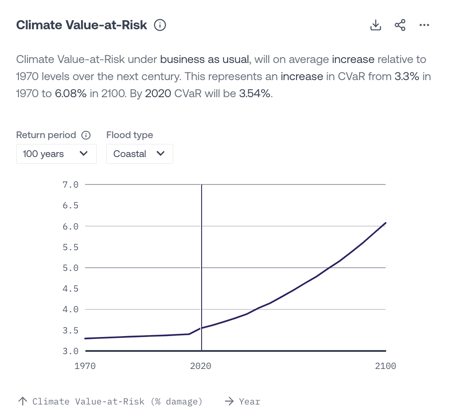
Climate Value-at-Risk (CVaR) is a metric that translates climate hazard exposure metrics into estimates of potential damage and losses to properties, or portfolios of properties, across different future climate scenarios. CVaR can provide a value estimate of potential damage that also takes into account uncertainty. In climate risk management, this can be used to differentiate asset exposure and vulnerability across asset types, regions and time frames.
Where is CVaR in EarthScan?
Currently, the CVaR Insight is available for two Risk Categories: Wind risk and Flooding (Coastal & Riverine).
- From the Navigation Panel, select ‘Wind risk’ or ‘Flooding’ from the Risk Category dropdown menu
- Scroll down through the Insights on the right side of EarthScan to the final Insight titled Climate Value-at Risk
- Select different return periods in this Insight to explore how the potential magnitude of expected damage to your assets due to physical climate risk varies
How is CVaR calculated?
To calculate CVaR, we model damage curves to infer asset-level vulnerability to climate hazards.
Damage curves (or damage functions) translate the intensity of a climate hazard an asset is exposed to into quantified financial terms such as physical damage.
For example, damage curves are used to estimate the extent of physical damage to an asset based on the depth of flood water inundation in a building. This can be translated into cost estimates for building damage and repair.
Learn more about the CVaR methodology in the EarthScan Ratings Methodology Overview.
How does CVaR help with climate-risk management?
Understanding climate hazard exposure and impact at the asset-level enables reporting that is decision-useful for investors. However, drawing a straight line between climate change and real world financial outcomes is complicated. The drivers of physical climate risk are not economic, which presents three key challenges for businesses wanting to identify their material climate-related risks:
- Discovering your exposure to climate hazards across geographically distributed assets
- Translating that exposure into impacts (i.e., physical damage to assets, site-specific disruption to business continuity)
- Translating climate hazard impacts into a meaningful financial metric
Assessing the potential damage and financial impact of climate events is an important part of climate risk management, due diligence and growth & acquisition strategies. Preparing for climate hazards can have a substantial impact on reducing the financial losses of extreme weather events. A 2020 report from McKinsey estimated that preparedness for physical risks can substantially reduce supply chain disruption losses relating to extreme weather events from 35% loss of revenue to 5% loss of revenue.